
The skillset taught by business educators today often focuses on planning, analysis and competition. This focus may equip students with the ability to maximise shareholder value, but today’s business goals go far beyond pure financial profit. As unprecedented challenges and disruptive technologies of climate instability, social injustices and systemic uncertainties test the resilience of European societies, social innovation emerges as a major contributor to solving these complex issues. Therefore, tomorrow’s leaders must be prepared to become successful social innovators. But how can educational institutions and support ecosystems rise to this challenge?
Key Competencies
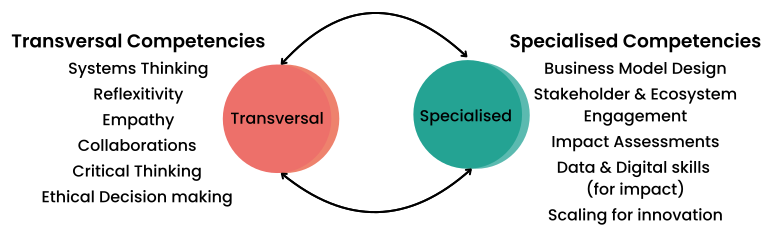
Figure 1: Two-tier competency framework for social innovation. Core (transversal) and role-dependent (specialised) competencies for developing purpose-driven change makers.
Business schools should teach two sets of competencies to equip students with the skills to build their careers as social innovators: Transversal competencies (foundational skills), and specialised competencies. Transversal competencies include for example collaboration, communication and critical thinking skills. Specialised competencies may include people management, innovation or financial skills. Every social innovator, no matter their role, requires transversal competencies to remain grounded, informed and resilient in their practice. They should therefore serve as the baseline of what every student is taught. Specialized competencies are dependent on the role they aim to perform in a team, and therefore require a more personalised approach. To learn more about social innovation skills, read this blogpost.
Pedagogies for social innovation
Beyond implementing modular learning curricula to ensure personalized learning outcomes, business schools need to rethink how competencies are taught to become successful social innovators. A transition from mere knowledge transfer towards transformational learning is necessary. This means that teaching methods need to go beyond explaining theory, and equip students with the practical, ethical and adaptive skills necessary to thrive in challenging times.
Transformational learning is experiential, interdisciplinary, reflective, and values-driven. Complex, real-world issues need to be addressed in class rooms, with the involvement of real-world actors grounding the learning process in community and breaking down barriers between faculties to bring together diverse perspectives. Continuous reflection on values and purpose must inform the learning process to prepare students for the ethical choices true leaders must make.
There are various methods to foster transformational learning, with challenge-based learning and hackathons as easy to implement options that educational institutions can put into practice without major involvement of outside actors or major changes in existing curricula. Methods like community-service learning and social innovation labs require considerably more resources, flexibility and effort. However, allowing students to engage with real-life stakeholders and develop real-life solutions could revolutionize business education for aspiring social innovators.

Figure 2: From easier to implement (base-level) to more complex to implement (top-level) approaches to social innovation pedagogies.
Challenges and Opportunities
Educational institutions often face considerable hurdles in their efforts to effectively teach social innovation. Rigid perspectives on course structures and learning outcomes may collide with novel teaching methods, and a lack of dedicated time, funding and administrative support inhibit the success of promising programs. However, these challenges are not insurmountable. A strategic approach is required to revolutionize business education, equipping future leaders with the tools to transform exciting ideas into practicable action.
To pioneer social innovation education, educators should start small, strategically building on the little wins gained along the way. Piloting methods of transformational learning in existing curricula is a first step towards shifting the culture of business education. Furthermore, educators need to work together across faculties, as interdisciplinarity benefits social innovation. Beyond breaking silos within educational institutions, business schools should work with local ecosystems, involving social entrepreneurs, NGOs and public officials in their projects. Not only would this benefit transformational learning, it can also build credibility and long-term relevance. Social innovation is central to address the most pressing issues of societies today. Business schools have the responsibility and the opportunity to evolve and pave the way for aspiring social innovators to become the changemakers we all need.
Learn more
The ESIC Project addresses business education for social innovation, aiming to upskill and reskill the European workforce, and thereby contributing to the transitions necessary for a social economy. The report “Empowering the Next Generation of Changemakers: A dual approach to social innovation education” by Philippe Eiselein, Bram Oers, and Dries Couckuyt is part of the ESIC project, and offers a practical framework for social innovation education.
Stay tuned here to learn more about the ESIC project and receive the latest updates on social innovation education in Europe.