
Social Innovators hold the key to a more sustainable future. However, they often remain ill-equipped to transform their potential into reality. Proper education on social innovation is therefore essential. But what are the competencies needed to become a successful social innovator?
The Social Innovation Competency Framework
Competencies describe a combination of attitudes, knowledge and skills necessary to successfully perform in a specific job. Competency based education (CBE) aims to teach not just academic theories, but real-world applications of knowledge, i.e. practical competencies. This is central for aspiring social innovators to thrive in complex and dynamic environments. Such practical competencies can be divided into two categories: Transversal, or basic, competencies, and specialized competencies.
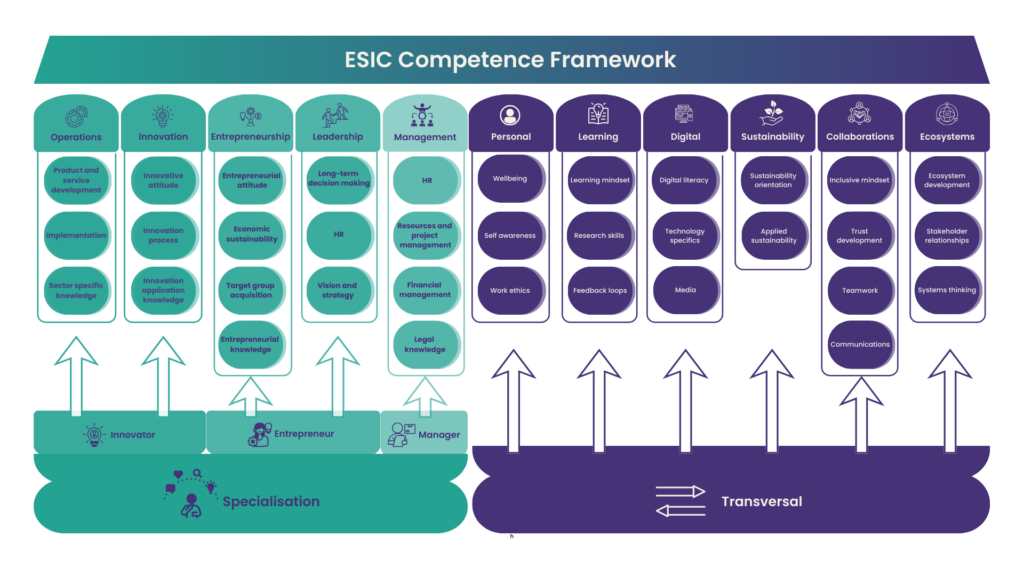
Figure 1: The holistic framework for Social Innovation competencies illustrates transversal (purple) and specialisation (green) competencies. Together, 36 component competencies represent a wide range of skills, knowledge and attitudes needed for Social Innovation.
Transversal Competencies: Every social innovator needs them
Social innovators operate in challenging environments. They need to navigate uncertain and ambiguous circumstances, often with minimal resources. To turn these challenges into opportunities, a set of five basic competencies are required.
- Personal: To persevere in difficult environments, social innovators must be driven by an innate sense of ethical responsibility serving as the basis for their mission. The professional is personal, and social innovators must foster their understanding of the communities they serve.
- Learning:Social innovators often operate with small teams and limited resources. Therefore, they require the analytical skills to identify opportunities for improvement in their efficiency, both for processes and products. Innovation goes hand in hand with agility and adaptability.
- Digital: To learn and improve effectively and consistently, social innovators need to apply technology strategically. The digital era demands tech-savvy innovators.
- Sustainability: Sustainability competencies must go beyond convincing storylines. The missions of social innovators must be grounded in knowledge about current social and environmental problems, and how they interact with policies and management systems. Social innovation is deeper than optics.
- Collaboration & Community management: Social innovators thrive in community. Interaction and collaboration between communities create thriving social innovation ecosystems providing empathetic and inclusive solutions to modern problems. An enticing story is important to bring together social innovators and social innovation communities in their mission for positive change.
Specialised competencies: Specific Social Innovation Roles
In addition to transversal competencies that every social innovator should possess, it is also necessary to develop the skills to perform well in certain roles. Teams should include team members with complementary specialized skills. Some social innovators may evolve to be able to perform all of them over time.
- The Innovator: Innovators identify problems and turn them into opportunities. To effectively perform this role, they require creativity and the ability to experiment, taking calculated risks to challenge the status quo. Their open and flexible attitude allows them to continuously learn and adapt, thriving in the ever-developing landscape of social innovation.
- The Entrepreneur: Entrepreneurs require business skills, knowledge about market dynamics, financial management and strategic planning, to make informed decisions, secure funding and ensure the financial sustainability of social innovation projects. Their role is about maintaining the stability of a project, thereby fostering legitimacy, both social and economic, among relevant stakeholders. For this purpose, beyond business skills, entrepreneurs require leadership competencies, building diverse teams and guiding them from idea to action.
- The Manager: Managers ensure that projects progress as they should. From planning projects, to executing and monitoring them, and eventually bringing them to a close, managers take on the role of effective coordinators. They need to manage resources efficiently, report on progress and lead their teams towards reaching strategic objectives.
From Competency Framework to Education
The skills and roles of this framework should be taught in the curricula of business and entrepreneurship education. Education needs to be flexible and adaptable to the needs of individual students to ensure they can craft the best fitting path to become social innovators.
To learn how transformational learning could transform business education to support aspiring social innovators, read this blogpost.
Learn more
The ESIC Project addresses business education for social innovation, aiming to upskill and reskill the European workforce, and thereby contributing to the transitions necessary for a social economy. The research paper “Shaping the future of social innovation education: A competency-based education perspective” was created as a part of the ESIC project, providing comprehensive insights into the requirements for social innovation education.
Stay tuned here to learn more about the ESIC project and receive the latest updates on social innovation education in Europe.