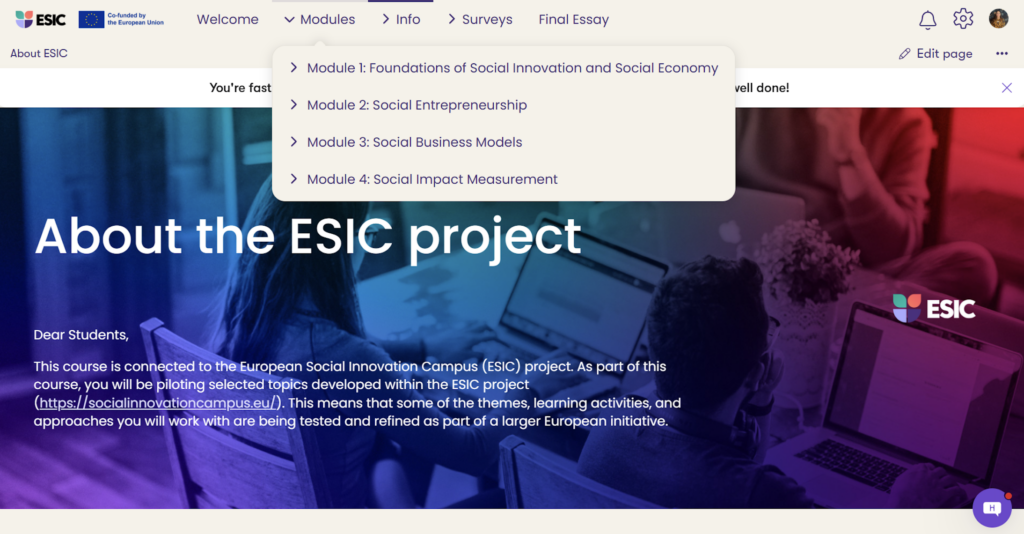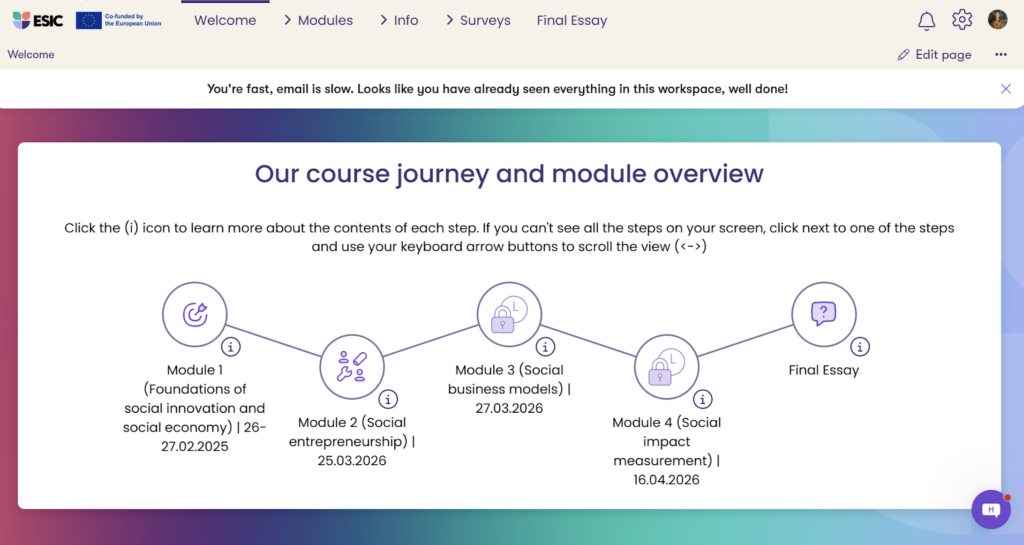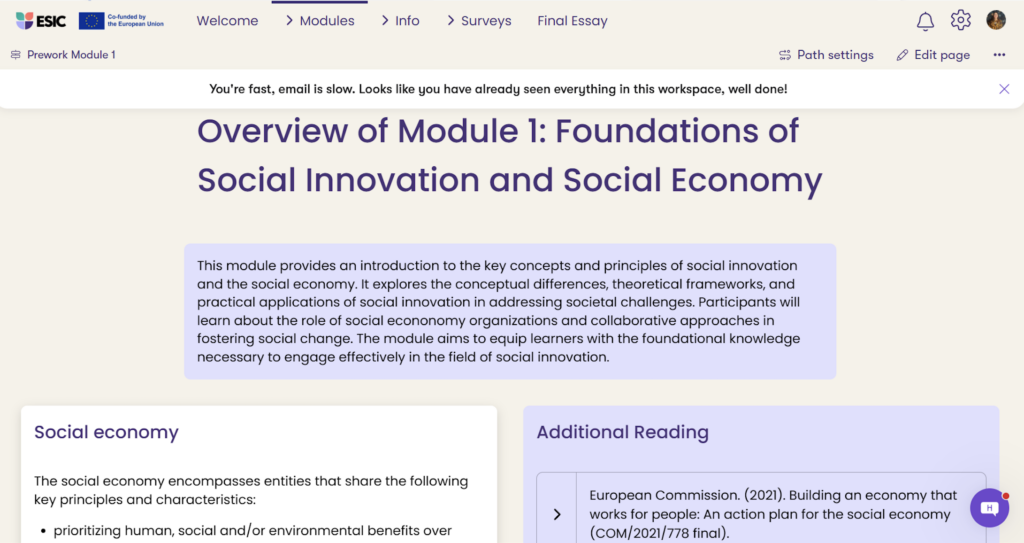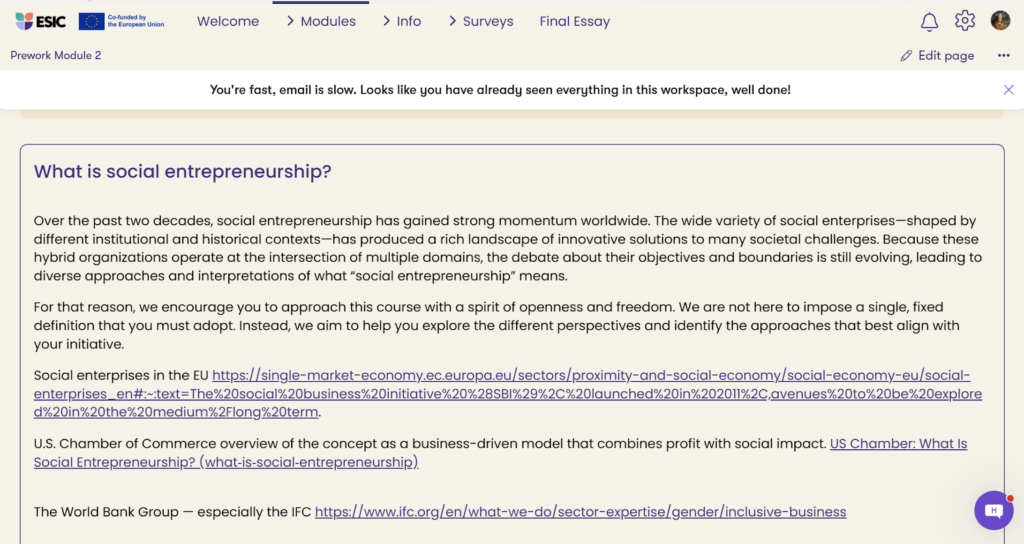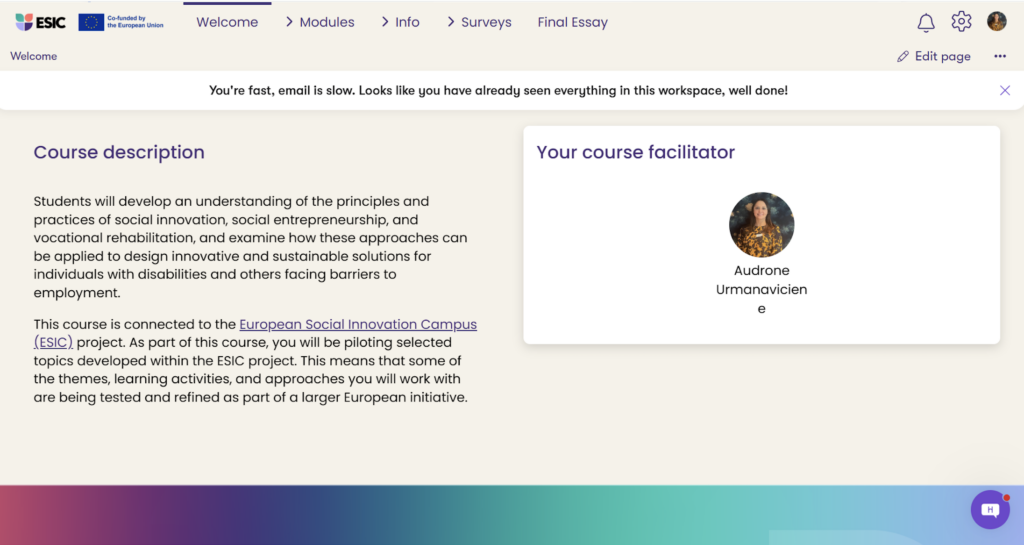
From 26 February to 28 April 2026, Tallinn University piloted the course “Social Enterprises and Vocational Rehabilitation” as part of the ESIC project activities under T4.2. The pilot was organised by the TLU SOGOLAS team and delivered online through the Howspace platform. The ESIC programme at TLU was led by Audrone Urmanaviciene, lecturer of social entrepreneurship at Tallinn University.
The pilot brought together university-level learners to explore key themes related to social innovation, social economy, social entrepreneurship, social business models, and impact measurement. In total, 29 students completed the course.
During the pilot, the TLU team covered the following topics:
- Using impact data for decision-making, communication, and improvement
- Social innovation, social economy, and social entrepreneurship
- Social value creation and examples of social innovation in practice
- Social entrepreneurship and social enterprise approaches
- Social business modelling, including the Business Model Canvas
- Theory of Change, outputs, outcomes, and impact
- Impact measurement tools, indicators, and evaluation methods
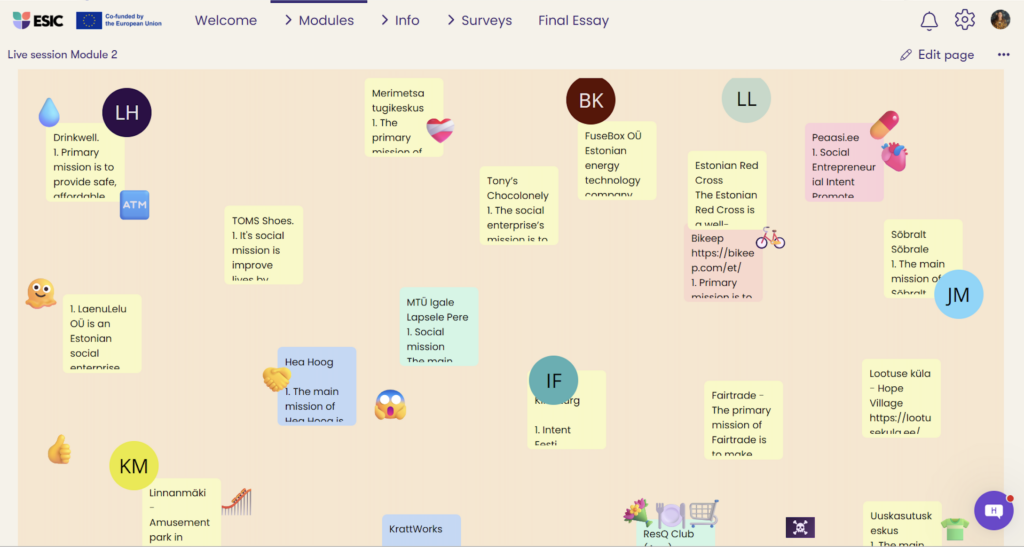
Throughout the course, learners engaged with practical examples of social innovation and social enterprises, examined the relationship between social economy and social entrepreneurship, and applied tools such as the Business Model Canvas and impact measurement frameworks. The sessions supported students in connecting theoretical concepts with real social and environmental challenges.
A special contribution was made by Lisa Petersheim from Rethink Ireland, an ESIC project partner, who delivered a guest lecture about Rethink Ireland’s activities, their approach to creating and measuring impact, and their incubator and accelerator programmes: https://rethinkireland.ie/. This helped participants better understand how organisations can support social innovation in practice, develop impactful initiatives, and strengthen the capacity of social enterprises.
The final assessment required students to prepare a short essay based either on a case study of an existing social enterprise or on their own social enterprise project idea. The submitted work demonstrated that learners were able to apply course concepts to different social, environmental, and community-based contexts.
We warmly congratulate all students who successfully completed the course and received their ESIC certificates. Their participation and final submissions demonstrated meaningful learning progress and a strong interest in social entrepreneurship and social innovation.
Overall, the TLU pilot showed that the selected topics are relevant and useful for developing learners’ understanding of how social entrepreneurship can address social needs, create value, and connect social impact with sustainable business planning.
Course impressions: