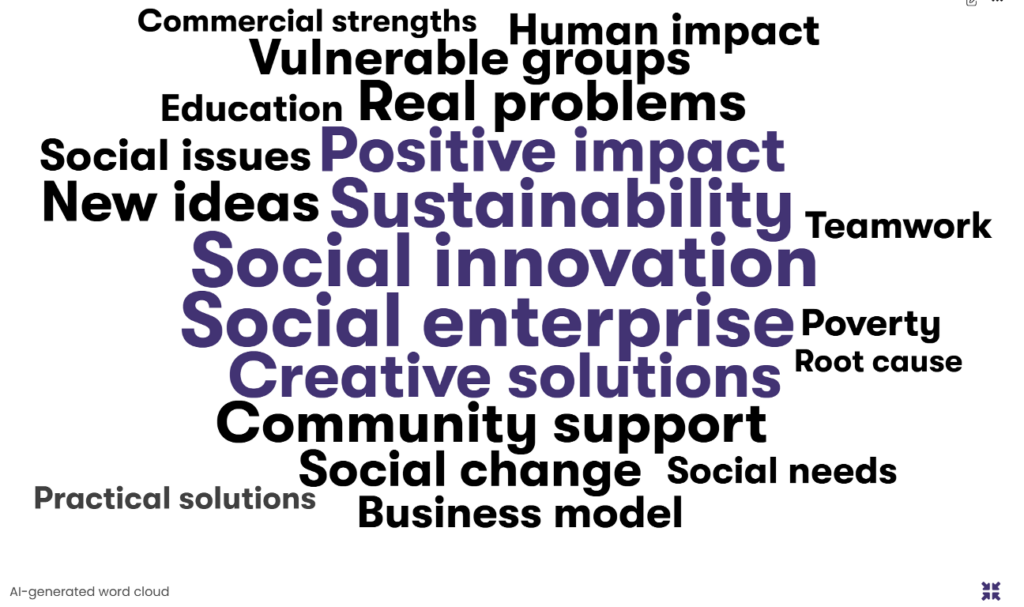
European Social Innovation Campus will pilot its social innovation curricula across all educational levels throughout 2026. Discover how Finnish students were motivated by practical problem-solving and chose to continue their social innovator journey beyond the pilot course!
A total of 22 bachelor-level social work students from Diaconia University of Applied Sciences enrolled in the English-language course, which focused on social entrepreneurship and social innovation. The study unit combined online learning, independent teamwork, mentoring and a face-to-face campus week. The pilot was carried out in May-June 2026 at the Helsinki campus.
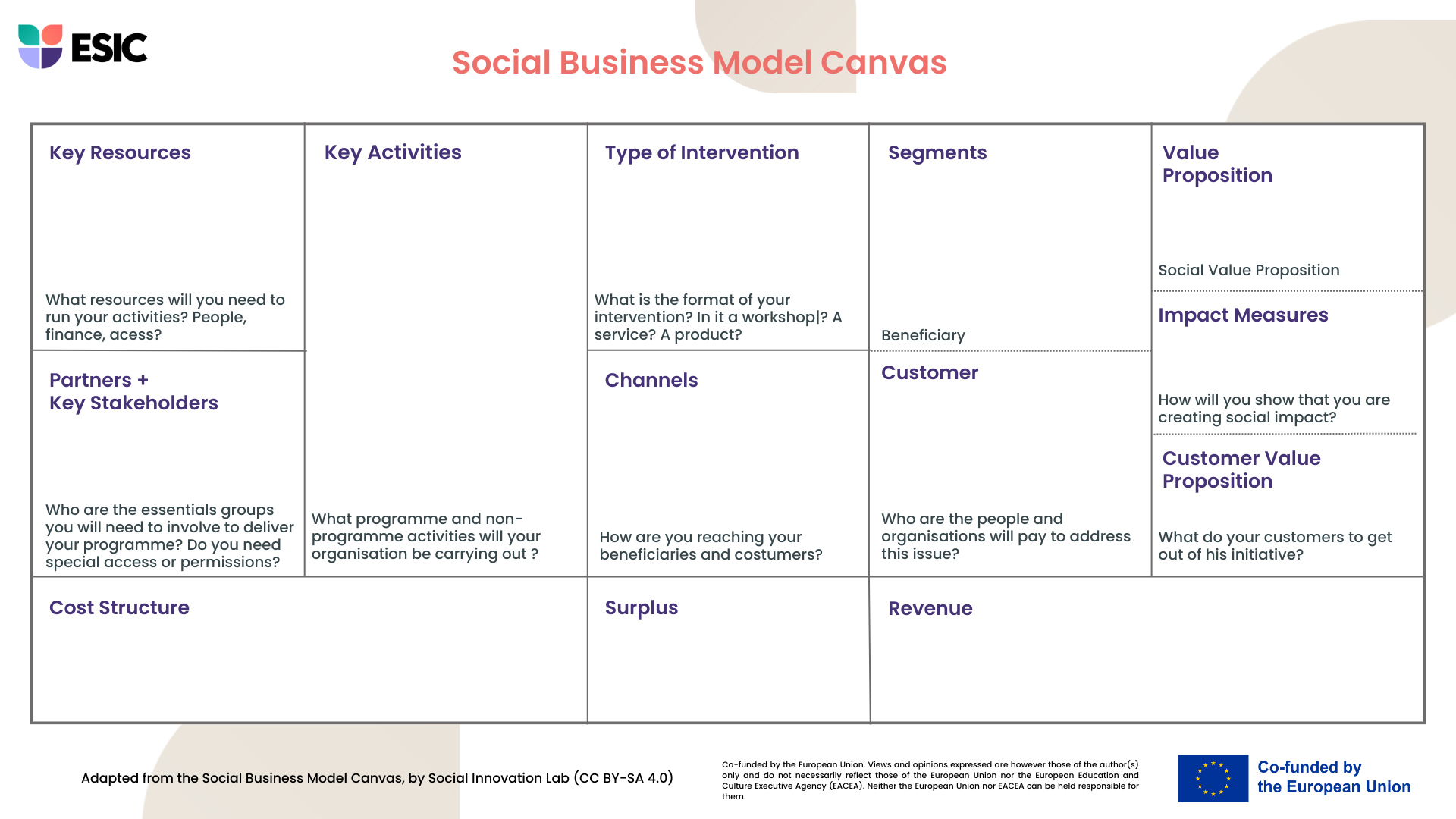
During the course, students worked in four teams. Each team explored a real-life “wicked problem” and turned it into a social enterprise business case. The challenges were defined either by the students themselves or together with their mentors. The teams used the Social Business Model Canvas throughout the process to shape, develop and present their ideas.
The course design followed Design Thinking pedagogy, which supported students in moving from identifying complex social challenges to creating practical and innovative solutions. This approach encouraged experimentation, collaboration and user-oriented thinking. The blended format also gave students time to work independently online before coming together on campus to test, refine and present their ideas.
Learnings of the pilot
One of the key strengths of the pilot was the close connection between students and working-life experts. Mentoring helped students connect their studies to real-world social innovation and gave them a chance to develop ideas that could be relevant beyond the classroom. The final presentations showed that students were able to apply design thinking methods and social business tools in a meaningful way.
What did we learn from the pilot? First, real-life challenges motivate students and make learning more concrete. Second, professional mentoring adds significant value to the learning process, especially when students are developing new and uncertain ideas. Third, the Social Business Model Canvas proved to be a useful framework for structuring social enterprise concepts. Finally, the pilot showed that students can create promising social innovations when they are given enough space, guidance and practical tools.
The expert mentors were pleased with the quality of the presentations and the solutions created during the course. Even more encouragingly, at least two of the teams are likely to continue developing their ideas after the pilot.
The Finnish pilot demonstrated that the ESIC social innovation curricula can offer a powerful pedagogical approach for social work education. It helps students not only understand social innovation, but also practise the skills needed to imagine, design and develop solutions for future social challenges.
Author: Diaconia University of Applied Sciences (DIAK)
Veera Semi
Impressions: